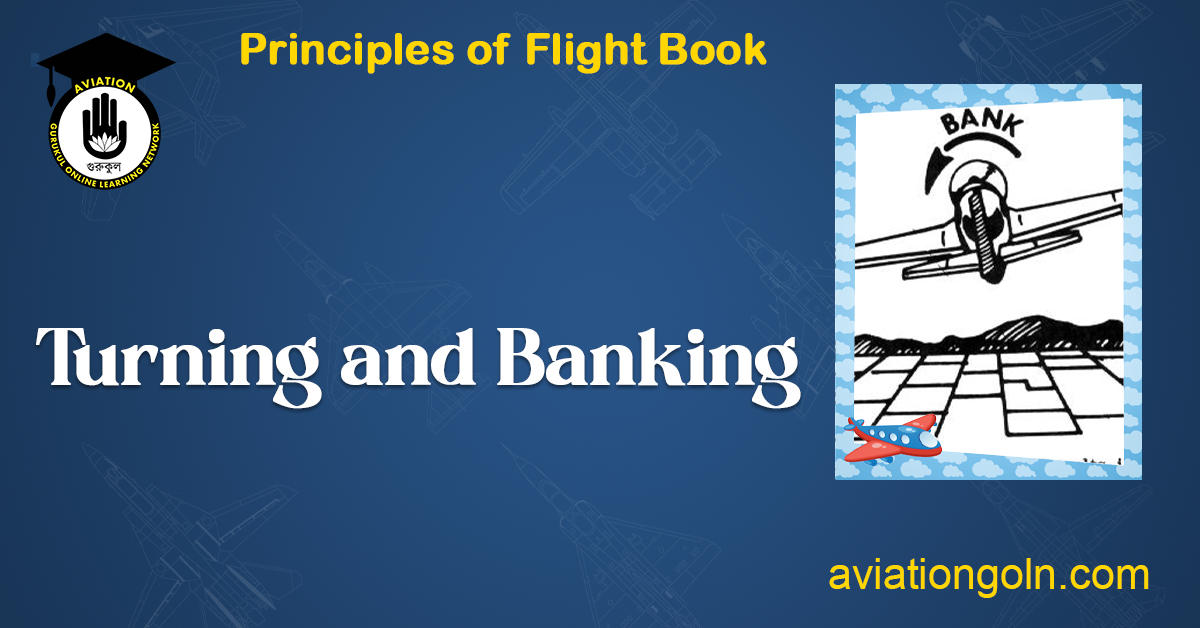
When aircraft traverse the skies, their movements are not always linear. Often, pilots must execute turns and banks to change direction, avoid obstacles, or line up for landings. These manoeuvres are not as straightforward as they may appear to an observer on the ground. They are a symphony of aerodynamic forces and principles at play. In this treatise, we’ll dive deep into the aerodynamics of turning and banking, providing insights into the physics and mechanics behind these essential aerial manoeuvres.

I. Introduction to Aerodynamics
Aerodynamics is the study of how air moves around solid objects, particularly aircraft in this context. Four main forces act upon an aircraft in flight:
- Lift: The upward force, produced by the wings, that opposes the weight of the aircraft.
- Gravity: The force pulling the aircraft towards the Earth.
- Thrust: The forward force produced by the engines or propellers.
- Drag: The resistance encountered as the aircraft moves through the air.
For an aircraft to remain in steady level flight, lift must equal weight, and thrust must equal drag. Any manoeuvre, including turning and banking, involves a change in the balance and orientation of these forces.
II. Basics of Turning in Flight
When an aircraft turns, it doesn’t merely steer in a different direction like a car. It banks, meaning it rolls to one side, tilting its wings. Here’s what happens step-by-step:
- Control Input: The pilot uses the control yoke or stick to initiate a roll, typically in the direction of the intended turn. This movement affects the ailerons, which are small hinged sections on the outer portion of each wing.
- Aileron Deflection: When the pilot inputs a turn to the left, for example, the left aileron moves up, and the right one moves down. This increases the camber (or curvature) of the right wing, producing more lift on the right and less on the left. This difference in lift causes the aircraft to roll to the left.
- Bank Angle and Lift: As the plane banks, the total lift vector tilts with the aircraft. The vertical component of lift must always counteract the aircraft’s weight to maintain level flight. As the bank angle increases, a greater proportion of the lift acts horizontally, creating the centripetal force required for the turn. This necessitates an increase in the total lift (and hence, angle of attack) to maintain level flight.
- Horizontal Component of Lift: This component becomes the centripetal force that causes the aircraft to change direction. The tighter the turn, the greater the necessary centripetal force, and thus, the steeper the bank angle required.
III. Turn Radius and Load Factor
Two important concepts when discussing turning manoeuvres are turn radius and load factor:
- Turn Radius: It’s the distance from the centre of the turning circle to the aircraft. A tighter turn has a smaller radius, requiring more centripetal force and a steeper bank angle.
- Load Factor: Also known as the ‘G-force,’ it measures the apparent increase in weight due to the acceleration in a turn. In a 60-degree banked turn, for example, the load factor is 2G, making the aircraft feel twice as heavy. This increases the stall speed, which can be dangerous if not managed properly.
IV. Adverse Yaw
When an aircraft rolls into a bank, not everything happens in perfect harmony. The wing producing more lift (the outside wing) also produces more drag, a phenomenon known as induced drag. This can cause the nose of the aircraft to yaw (turn) away from the direction of the intended turn, a situation called ‘adverse yaw.’
Pilots counteract adverse yaw using the rudder, which controls the aircraft’s yaw motion. This is why coordinated use of ailerons and rudder is crucial in turns.
V. Turning Performance and Limitations
An aircraft’s turning performance can be influenced by several factors:
- Aircraft Design: Planes designed for agility, like fighter jets, can sustain much tighter turns than large commercial airliners.
- Speed: An aircraft’s speed affects its turn radius. Higher speeds result in wider turn radii.
- Bank Angle: While steeper bank angles can produce tighter turns, there’s a limit. Exceeding the critical bank angle can cause an accelerated stall.
- Altitude: Air density decreases with altitude. At higher altitudes, for a given airspeed, the true speed (ground speed) of the aircraft is higher, leading to wider turns.
VI. Aerodynamics of Banking without Turning
Sometimes, an aircraft might bank without making a complete turn, often to counteract wind drift or to align with a runway during crosswind landings. The principles remain similar: ailerons control the roll, and lift is vectored to provide the necessary horizontal component.
VII. Safety Considerations in Turns
- Stall Speed: As mentioned, the stall speed increases with the square root of the load factor. In a steeply banked turn, the aircraft can stall at a much higher speed than in level flight.
- Structural Limits: Excessive load factors can stress the aircraft’s frame, potentially leading to structural failure.
- Spatial Disorientation: Pilots can sometimes misjudge their bank angle or become disoriented, especially in conditions of poor visibility. Proper training and reliance on instrumentation can mitigate this risk.
VIII. Conclusion
The seemingly simple acts of turning and banking are, in fact, intricate dances of aerodynamic forces. Whether a pilot is banking a small Cessna in a gentle arc or a fighter jet is executing a high-G turn, the principles remain rooted in the balance of lift, gravity, thrust, and drag. A deep understanding of these principles ensures not only efficient manoeuvres but also the safety of those aboard and the integrity of the aircraft itself.